
The Centre's ambitious Rs 6-trillion National Monetisation Pipeline (NMP) could fall short of yearly targets for the current fiscal year (FY22) and the next one as well (FY23), partly due to the long gestation period in monetising big-ticket railway infrastructure, Business Standard has learnt from sources in the finance and rail ministries. Officials say the major chunk of railway monetisation will happen from FY24 onwards because leasing some of the infrastructure, like stadiums and dedicated freight corridor, will not happen anytime soon. Rail infra is expected to be the second-biggest contributor to the NMP, with about Rs 1.52 trillion worth of assets to be monetised.

The Indian Railways has closed 2013-14 with a 15 per cent increase in revenue, rising to Rs 1,40,485 crore, compared to Rs 1,21,831 crore last year.

The Union Government's fiscal deficit remained above the annual target for second month in row at the end of August, mainly on account of the impact of lockdown on revenue collections. According to the data released by the Controller General of Accounts (CGA), fiscal deficit during April-August was at 109.3 per cent of the annual target estimated in the Budget.
The fiscal deficit was 4.9 per cent of GDP in 2012-13.
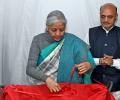
The interim Budget proposals that will be presented on February 1 in the backdrop of the general elections scheduled in April/May 2024 are likely to have a hint of populism, believe analysts, but are unlikely to derail the government from its path of fiscal prudence.

The fresh meat and seafood delivery startup Licious plans to set up 500 stores nationwide within the next five years as part of an omnichannel strategy. The aim is to attract new users in the offline channel and encourage them to transact online as well. The move would also help the company in its efforts to achieve profitability and go for an initial public offering (IPO) in the next 24 months, according to the sources.

From its lows this month, the stock of Sona BLW Precision Forgings is up 10 per cent on better-than-expected results. The stock rose by 4 per cent in the trading session on Tuesday after Japan's Nikkei Group said the Indian automotive component major has topped its rankings in terms of competitive advantage. The rankings are based on sales, profit margin, capital expenditure, research and development, and market capitalisation.

Alloting more funds for MNREGA and PM-KISAN could wipe out the entire additional money that the Centre may have for FY25.

Mumbai-based developers Macrotech Developers (Lodha) and Oberoi Realty have emerged as top gainers among largecap realty stocks over the past month, with gains ranging from 29 per cent to 33 per cent. Strong ongoing sales trends in Mumbai's core market, record bookings in the January-March quarter, and healthy guidance for 2024-25 (FY25) have propelled these companies, which derive the majority of their revenues from India's financial capital.
Long-term macro trends indicate growth in demand for air travel. Trends from the ticketing website MakeMyTrip indicate a likely annual growth of between 11-17 per cent in Indian air travel demand over FY24-30. Through that period, InterGlobe Aviation or IndiGo may continue to make gains in market share in both domestic and international travel, aided by large fleet additions. IndiGo is the largest global customer of Airbus by far with 950 aircraft orders outstanding.

With the last quarter of 2023-24 (FY24) expected to have been soft owing to lower discretionary spend and macro uncertainty, many are hoping FY25 will be a year of recovery for the information-technology (IT) industry. The fourth quarter, January-March, is considered soft, and will continue to see the headwinds the sector has been facing. And the sector has entered the new financial year on a weak footing. Analysts are expecting Tier-I firms to report sequential growth of -1 per cent to 1.5 per cent and midcap players' growth may range between 0.7 per cent and 4 per cent.

Prime Minister Narendra Modi led-NDA government in its third term must tackle the problem of unemployment in the country, especially in the unorganised sector and in small and medium enterprises, former NITI Aayog Vice Chairman Rajiv Kumar said on Monday. Kumar also emphasised that the government now must finalise the four labour codes as it has been delayed beyond expectations. "We must recognise that post-COVID economic recovery has been a K-shaped recovery.

'The hiring in India will be primarily around skills in data engineering, AI, and product engineering.'
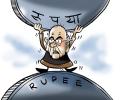
For the first eight months of the current financial year, the figure stood at Rs 7.17 trillion.
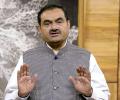
Adani group saw a 55 per cent profit surge in the fiscal year ended March 2024 as the apples-to-airport conglomerate is back on an expansion spree and eyeing a $90 billion capex over the next decade. Emerging from a damning report of a US short seller, which hit market value of its listed companies, Adani group in 2023-24 (April 2023 to March 2024) fiscal focused on containing debt, reducing founder share pledge and consolidating business in core competencies.

The World Bank on Tuesday raised the growth forecast for the Indian economy to 7 per cent for the current fiscal year on the back of recovery in agri sector and rural demand. World Bank had in June projected India to grow at 6.6 per cent for FY24. According to the World Bank Report released on Tuesday, India's growth continues to be strong despite a challenging global environment.

Only 80.6 per cent of the Rs 6-trillion allocation has been spent by February, data from the Controller General of Accounts shows.

The paper said that the taxation proposal needs to be accompanied by explicit redistributive policies to support the poor, lower castes, and middle classes.

Coal India's (CIL's) revenue for the first quarter of 2024-25 (Q1FY25) came in at Rs 36,500 crore, up 1 per cent year-on-year (Y-o-Y) and down 3 per cent sequentially, which was in line with consensus. The blended average selling price was Rs 1,687/tonne, down 5 per cent Y-o-Y and down 1 per cent Q-o-Q, which was below estimates. The adjusted operating profit (excluding overburden removal or OBR costs) stood at Rs 11,500 crore up 3 per cent Y-o-Y and up 17 per cent Q-o-Q, which beat the street. This was due to lower operating expenses.
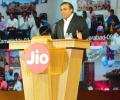
The launch of services by Jio in September 2016 had disrupted the whole telecom sector, with operators matching low rates to maintain competitive edge

Both factions of the Jamiat Ulema-e-Hind (Arshad Madani and Mahmood Madani) slammed the Bill and expressed grave concerns over the proposed legislation.

The stock of Voltas, the country's largest room air- conditioner (RAC) maker, is up 22 per cent in the past three months. Robust demand on the back of a sweltering summer, distribution expansion, slew of launches and backward integration are expected to forge a good operating performance for the company. In the core RAC segment, there are multiple triggers for the company.

'The numbers are null and void now. Look, we can give out projections now, but we know that a week later those numbers will also be irrelevant. So we need to wait,' a top government official said.

In an unprecedented move, amidst the ongoing row between the Kerala governor and the Left Democratic Front government, Governor Arif Mohammed Khan on Monday shared with the media video clippings of him being allegedly heckled at a Kannur University event in 2019.
Officials said there had been no official word or indication from the top yet. The expectation from officials is to do what they can, but it is understood that all fiscal and budgetary targets don't matter anymore.

Even with the possible expenditure roll-overs and off-budget financing, the fiscal deficit target will not be met. The FRBM Act, after its amendment in 2018, allows a fiscal deficit slippage of not more than 0.5 per cent for any given year, provided there are justifications. These justifications include war, national security, severe collapse in the agriculture sector, a major natural calamity, big structural economic reforms, or the decline in real output growth of a quarter by at least 3 percentage points below its average of the previous four quarters.

The National Highways Authority of India (NHAI) is looking to monetise 33 stretches of national highways during the current financial year (FY25) through its toll operate transfer (TOT) and infrastructure investment trust (Invit). These stretches include Lucknow-Aligarh, Kanpur-Ayodhya-Gorakhpur, and Bareilly-Sitapur in Uttar Pradesh, Gurugram-Kotputli-Jaipur bypass and Jaipur-Kishangarh in Rajasthan, Panikoili-Rimuli in Odisha, Chennai Bypass in Tamil Nadu, and Muzaffarpur-Darbhanga-Purnia highway in Bihar. Cumulatively, the 33 stretches, spanning 2,741 kilometres (km) earned approximately Rs 5,000 crore revenue in FY24.

Budget-makers in North Block are looking to maintain this fiscal status quo, in spite of tax revenues nowhere close to where the government wants and in spite of possible higher expenditure commitments.

Tata Communications has seen analyst upgrades after reporting Q3FY24 results. The biggest factor is the visible signs of a turnaround in its new acquisition, Kaleyra. The consolidated revenue grew 16 per cent Q-o-Q to Rs 5,630 crore led by 15 per cent Q-o-Q improvement in the data segment.

In the October-December quarter (Q3) of FY24, Hindalco reported flat consolidated revenue year-on-year (Y-o-Y) at Rs 52,800 crore. Copper revenue rose due to higher shipments and better Average Selling Price (ASP). Revenue from the aluminium vertical and Novelis declined 3 per cent and 6 per cent Y-o-Y, respectively.

PVR-Inox is in an inherently fickle business. If there is a string of flops, the box office collections will be weak. Conversely, Q2FY24, which witnessed several hits, has brought about an upside in revenues. However, the merger has led to market share gains and synergies that helped bring breakeven down to approximately 20 per cent occupancy.

All eyes will be on whether Sitharaman will deliver a populist budget leaving more money in hands of the common man or push the reform agenda by staying on the fiscal glide path to lower the fiscal deficit to 4.5 per cent of GDP by 2025-26.

The government has limited room to reduce expenditure without further weakening growth, it noted.
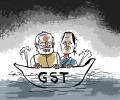
Bihar Deputy Chief Minister Sushil Kumar Modi said, a hike in GST rates would have hampered consumption amid the economic slowdown. The revenue augmentation panel in the Council meeting recently recommended revisiting and restructuring the GST rate slabs, besides correcting the inverted duty structure. The panel listed 24 items, including mobile phones, footwear, fabrics, LED light, medical equipment, utensils, agri machinery, pharma, and renewable components, which have an inverted duty structure, resulting in refunds of close to Rs 20,000 crore annually.
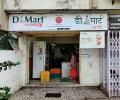
Shares of Avenue Supermarts (DMart) have gained about 5 per cent over the past week on better than expected June quarter (Q1FY25) performance, hopes of a recovery in discretionary demand, and margin gains going ahead. The key takeaway from the results was the robust gross margin performance. Riding on improving mix, DMart posted a 34 basis point year-on-year (Y-o-Y) improvement in gross margins to 14.9 per cent.

Revenue from divestment has fetched Rs 40,000-50,000 crore against target of Rs 2.10 trillion.

From its lows this month, the stock of Bharti Airtel is up 14 per cent. The gains for the telco have come on the back of expectations that market share consolidation, tariff hike and lower capex should boost margins and profits. While the company is a key player in the Indian market, it also has a leadership position in major markets of Africa.

'We are looking at the next target which is to be a $1 billion ARR firm in the next 4-5 years.'

There is no impediment to normal operations as Tata Motors puts in place the demerger process of its commercial and passenger vehicles businesses. Instead, the demerger would provide greater manoeuvrability for both new entities to operate independently, according to Tata Motors management. While there may not be immediate value unlocking, it will give investors clarity about future growth and the financials across different segments.

Wipro's new CEO Srinivas Pallia will receive an annual remuneration of up to $6 million (about Rs 50 crore), according to a regulatory filing by the Bengaluru-headquartered IT company. Earlier in April, Wipro announced the appointment of Pallia as its new CEO and MD, following the sudden resignation of Thierry Delaporte. Delaporte's annual salary of over Rs 80 crore at Wipro had made headlines last year.
